What a YouTube Share Actually Is
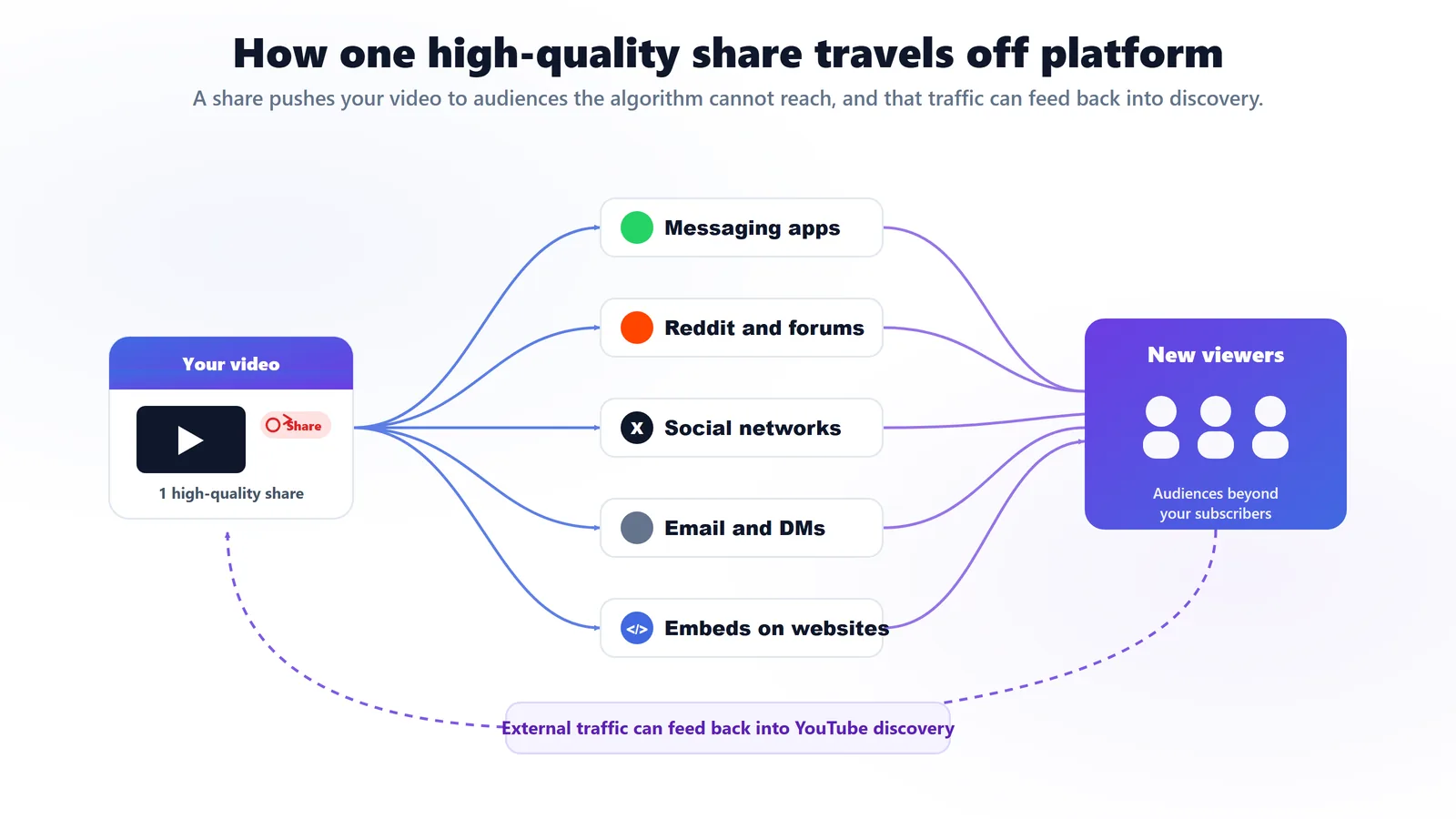
Start here, because it reframes the whole purchase: a share is not a vanity number, it is a distribution action. A like or a comment stays on YouTube. A share leaves YouTube and lands your video in front of someone who was never going to see it.
When a viewer taps Share, YouTube opens a panel and hands them ways to send your video somewhere else: a social network like Facebook or X, an email, an embed on a website, or a copied link they paste into a chat. (YouTube Help: share a video.) On a phone, that same panel also surfaces the apps people already use, from WhatsApp to Reddit.

A share is the one piece of engagement that travels. It is your video walking out the front door of YouTube and into a conversation somewhere else, in front of people who do not yet follow you.
And YouTube does keep score of it. In YouTube Studio, the Engagement tab reports a Shares metric alongside likes and comments, and it even breaks down which apps people used to share, so you can watch your distribution happen. (YouTube Analytics basics.)
What a share really does
- Sends your video off platform to people who do not follow you.
- Creates external traffic, a source YouTube recognizes as its own.
- Doubles as social proof; a video worth sharing looks worth watching.
What a share is not
- A direct ranking button. Watch time and retention carry far more weight.
- A way to monetize. Shares are not in the Partner Program formula.
- A fix for a weak video. Distribution amplifies, it does not rescue.
The honest takeaway. Buy shares to widen distribution, not to game a number. Every other YouTube signal works inside the platform; shares are the one that reaches outside it. The rest of this guide is built on that single distinction.